

Solar
If I really sat down to think about it, my solar quest started based on a combination of multiple factors. I have spent more time than one really should researching this, and after all of that research, the only way I could really decide if this was “worth it” was to actually do it. There were just too many variables and I could not land on a single reason that screamed “yes! do it” or “no, don’t under any circumstances do it”. All of my research pointed to “yeah, it will probably be worth it… maybe”. So with that 60-80% hand wavy “probably”, I dove in. There were many reasons why I wanted to go solar, but my top reasons are as follows:
Wanting to be off grid and self sufficient – Our house is in a neighborhood with about 15 other homes that is surrounded by farmland and we lose power all the time. The issue with my neighborhood is that since we are off the beaten path, response times for power restoration can sometimes be long. We also have all above ground power lines, so they are prone to downed trees, wind and just general mother nature. Also, just in case the apocalypse happens, being off grid might help us survive a few extra weeks. At least until the roving gangs of teenagers and regional warlords take over – which I think is somewhere between phase 3 or 4 of Orlov’s 5 Stages of Collapse model.
A deep hatred of our local utility company (BGE) – Over the last 20+ years since I moved to Maryland the cost of electricity has been rising. Now, I know this is not uniquely a Maryland thing and there are many factors that contribute to that – but I have always felt like utility companies become more monopolistic as time goes on. Also, US energy policy and infrastructure just isn’t where it needs to be to be cost effective. Every time I go to Europe and see this, it makes me wonder.
Environmental renewable energy reasons – Solar energy is a leading renewable green technology that converts sunlight into electricity (via photovoltaics) or heat (via thermal systems), producing no greenhouse gases during operation (although I will concede that their production does leave a carbon footprint). As a rapidly growing, cost-effective, and sustainable energy source, it helps reduce reliance on fossil fuels. I fully acknowledge that I have a battery for backup power and I know that’s not the most environmentally friendly thing in terms of how recycling goes, at least currently. However, I am hopeful that as a society we look to expand our capacity to deal with this challenge and support the critical research needed to address this.
My desire to save (and make) money – The promise of cheaper energy has always intrigued me. If I can pay less for something, I generally will. But in terms of investing in something that not only saves me money, but has the potential to actually make me money – sign me up.
This is a long and ever evolving post. So I decided to break it up into sections.
Pre-Solar Assessment
Based on all the research I’ve done, there are a few main questions you need to answer before you can decide if solar is right for you. I based my decision to go solar using the following set of questions.
Is my house (or property) solar friendly?
This question basically is trying to determine if you have enough roof space for the amount of panels you might need, or do you have an area on your property that you could put a ground based solar array on – and does that area get enough sun.
For me, I opted to put my solar panels on my roof. Part of that decision came from the fact that I have a ranch style house that gets constant sun the entire day on some part of the roof. I also have a new roof (less than 5 years old) so the risk of having to pull the panels off to replace the roof is slim. I did however ask my homeowners insurance if they would cover removing and replacing the solar panels if a covered event (like hail) damaged the roof and it had to be replaced. They said yes, but I would check with your insurance carrier first if that is important to you. For what it’s worth, Google said it costs an average of $2k-6K to remove and replace the panels if you have to have your roof redone.
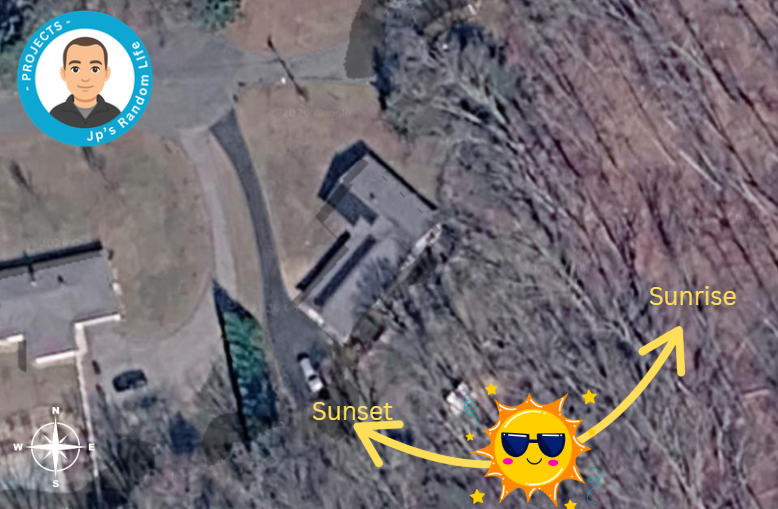
My house is a 3-bedroom, 1,700 sq ft ranch-style house located in Anne Arundel County Maryland. It was built in the mid 1970s. We purchased the house in 2023 and have been working to increase energy efficiency anywhere we can. My front door faces slightly northwest, and I am surrounded by trees. The good news for me though was that even though I was surrounded by trees they are back far enough where my roof got sun almost all day. Looking at the picture below, you can see how my roof’s orientation is and the direction the sun travels throughout the day. You can use a free tool called ShadeMap to see how the sun goes around your house in case you have never actually thought about it before.
What are my current electrical demands?
This is a hard question for most people to answer, especially if they have not been monitoring their electrical needs. If you don’t monitor your usage, the first place you should look is your utility bill. Most bills don’t show your day-to-day usage as granularly as you’d like, but they do allow you to average what your monthly and daily usage could be. We only use electricity at the moment; our heating is oil, so my bill only shows electrical usage. I will also say that I do have pretty solid insulation, all Energy Star appliances, every light in the house is an LED light, and I am a stickler for making sure shades are open/closed when appropriate to maximize my energy efficiency – so my bill may not be reflective of yours. Full disclosure on this bill, we bought our house in May of 2023 and it was sitting for a while so there was limited electrical usage before we moved in at the end of May 2023, but the below is what I used to average what my needs would be.
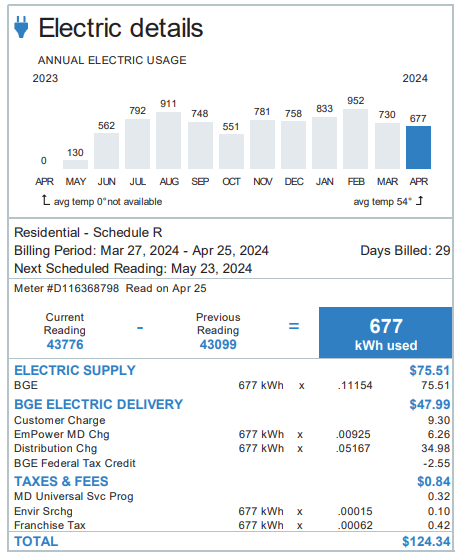
Based on the bill above, you can see how I estimated my solar electrical generation needs. You can do this in one of two ways. You can either – Average out each month – which in my case was 754 kWh per month (or an average of 25 kWh / day when you assume 30 days in a month). Or – you can take your highest month and assume that’s the most you would need to generate in a month – which in my case would be 952 kWh per month (or ~31.7 kWh / day when you assume 30 days in a month).
When I did this, I went with the second method of taking the highest month and averaging per day. I talked to 5 different solar companies and they all had their own special way of coming up with the math, but it all came down to averaging and estimating. You will want to also add some overhead/extra when coming up with this estimate to cover days when you either increase your demands (laundry or have guests) or for days the sun isn’t fully out and your panels are producing less power per panel. When solar companies show you potential electrical production they will show it to you on 100%, 110% or 120% of your electric needs. So with that said, when I was talking to different solar companies, I estimated that my daily solar electric production needed to be 38.5 kWh (31.7 kWh + 20% for spikes and future appliances – rounded up – or 120% of my electrical needs). I probably over estimated, but I plan to eventually move to a tankless water heater vs the 60gal electric water heater tank I currently have and my wife is trying to talk me into heated floors in the bathroom – so I wanted some wiggle room on what we needed to generate.
Miscellaneous Requirements and Considerations
Like I mentioned before, my requirements may not be like yours, but it’s good to see what others are doing. In my case, since we lose power a lot, I had to make sure that whatever battery system I chose could handle the items I wanted to power if/when we lose power. Standard items like the refrigerator, lights and the stove were on the list, but there were some considerations I wasn’t expecting that really narrowed the field when looking for a battery backup solution. In particular, we have a well. A well uses what is called starting power when it starts – and this is considerably more than what is needed to keep it on. Air conditioners and some large heat pumps are in the same boat. In my case, the well was my priority and high starting power was necessary. A lot of companies make batteries that can do this, but they usually require more than one battery. Unfortunately, based on the cost of multiple batteries I was in a jam and opted to wait until Tesla released its Powerwall 3. The installer I chose (Lumina Solar) didn’t have the Powerwall 3 available for customers until September of 2024. So I waited for that.
Note ** If you do not have a battery backup solution, you cannot use your solar system during a power outage as you can’t just power your house on solar, it has to be stored, converted, then used. Some people believe that if the grid goes down and they have solar they are good – this is not the case. You need a battery.
Financials
Ahh, the proverbial – how much will this cost me? Most people like to view cost as how much per month they will have to spend. Personally, I look at cost as total cost of ownership and how long until the solar system begins paying for itself.
My base system cost
The system I chose consisted of 24 panels and 1 Tesla Powerwall 3 – but more on the system design in the next section. When I first started working with Lumina Solar they gave me a breakdown on what they estimated the costs to be based on my requirements. This is the exact spreadsheet they gave me.
*** I am aware the 30% Federal Solar Tax Credit is no longer available. But, this is what my financials looked like. ***
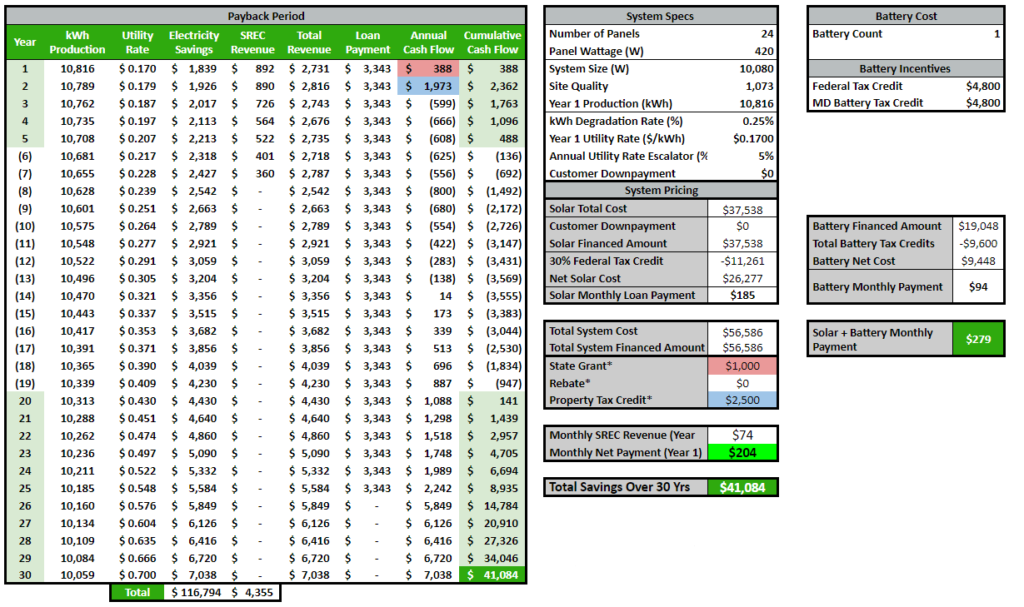
This looks like a lot and can be confusing at first, even for those of us with a math degree. But the things you want to concentrate on (at least IMO) are your tax rebates and total cost. The first thing after I got the above spreadsheet from Lumina Solar was to call up my accountant and make sure I could take advantage of the full 30% tax rebate, which I was able to (win!). The spreadsheet breaks the system out in terms of solar array and battery, but for the purposes of the tax credit you have to look at the total cost, and that’s where the spreadsheet didn’t really add up to reality and it appeared to be more of a sales tactic, but the end cost and per month bill was pretty spot on. For me, an easier way to look at the total system cost breakdown looks like this:
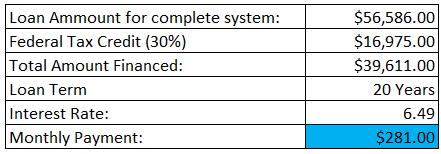
One strange thing with the federal tax credit and the solar loan is that initially you take out the loan for the full amount, so in my case $56,586. Then when you get your federal tax credit, you push that lump sum to the solar loan, reducing the total loan (which to me seems like math tricks to get you to sign up). When they show you the loan tables, they base everything on the fact that you will take that 30% tax credit and property tax credit and battery credit and just push it to the loan – and all monthly payment numbers are based on the full amount minus those credits. If you don’t do that, the loan payment becomes much higher – in my case, it would be on the order of $421/month without the credits applied. Another strange thing with a solar loan vs a regular loan is that they base all numbers on the assumption that you will get the 30% tax credit. So if you don’t get the full credit, you could end up paying more than you originally thought – so talk to your accountant first! They also give you a grace period to get your taxes done and get your refund back before they lock you into your monthly payment. In my case, I got the system installed in November 2024 and got my refund in May 2025. So for those first few months, they had me paying what my assumed monthly payment would be, counting on me pushing my tax credit to the loan. If I didn’t, like I said, after May it would go back up to $421. Kind of a strange lending process.
In terms of the county tax credit and the battery credit, I just took the straight credits and put them to buying a zero-turn mower. One cool thing about the solar loan (and I’m sure some other loans are like this) is that you can push large sums of money to it and they will re-amortize it for you. I think with the one I have, they will take another look at my monthly payment if I push an extra lump principal payment of more than $1000 limited to something like once every 2 years or something. So say I get a bonus at work (HA! I work for the government… but in this fantasy just go with it), I could throw that to the loan and it would reduce my monthly payment after re-amortization.
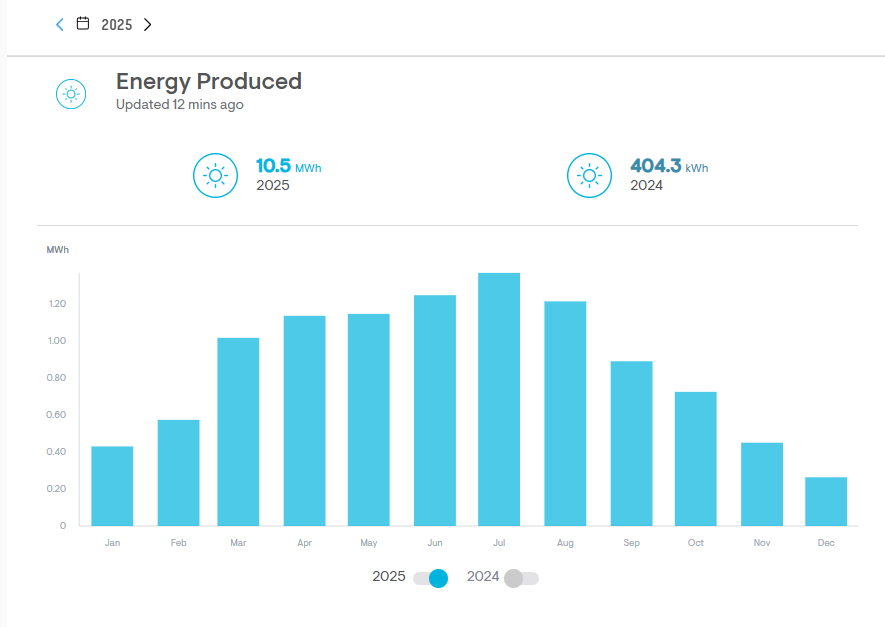
In addition to the credits when you purchase the system, you also (at least in my case in MD) become eligible to sell Solar Renewable Energy Certificates (SRECs). Basically you have to own your solar system (purchased or financed) and meet some hardware requirements in terms of size of the system, get a state certification and ensure that your system production is tracked. All of this was set up by Lumina Solar for me when I signed up. These SRECs are then sold on an exchange (all automatically – there is nothing I have to do). Every time my system produces 1MWh (1000 kWh) of solar energy, I get issued an SREC by the company tracking my solar production. What makes the SREC confusing at first is that most people think that the 1000 kWh that you generated has to be sold back – it doesn’t. An SREC is a tradable financial certificate that represents the environmental benefits of generating solar electricity. Because state laws require utility companies to source a portion of their energy from solar, they buy SRECs from solar system owners to meet these goals. For an MD SREC, I make between $40 and $65 for every SREC certificate that I sell on the exchange (which like I said is all automated and handled by the exchange – in my case xpansiv.com, formerly SRECTrade.com). As you can see, in 2025 I earned 10 SRECs. Fun fact, they carry over per month – so if you only produce 600 kWh one month, and then the next month you produce 900 kWh, you would earn 1 SREC for the 1 MWh and then the additional 500 kWh would keep rolling until you reach your next 1MWh. They aren’t determined by time; for every cumulative 1MWh of generation, you create an SREC.
Something else to consider when you look at the financials is the actual kWh cost that your electric company is charging you. If you look at my bill above, in 2024 the electric company was charging me about $0.11/kWh ($0.16/kWh if you include the distribution charge) in April. So, the chart Lumina Solar gave me wasn’t that off – they estimated the first year I owned solar that BGE would charge me about $0.17/kWh (I’m not sure whether they included the delivery charge in that or not). As a comparison, the current May 2026 BGE rate is about $0.23/kWh (with delivery charge). Just following any of the local social media platforms, you can see people are definitely noticing a rate hike, and this is just the beginning. While we don’t know for certain, watchdogs have warned that aging infrastructure, weather pattern changes affecting system reliability (think costs to repair damaged infrastructure) and surging system demand (think datacenters) could increase overall electric bills by up to 60% over the next decade.
OK, so now that I’ve shown you what I actually paid for the system, let’s look at some return on investment. The below chart is my current usage as BGE sees it from April 2025 through April 2026. This is a good overview, but I track this more granularly in a different way which I will lay out when I talk about post-install usage.
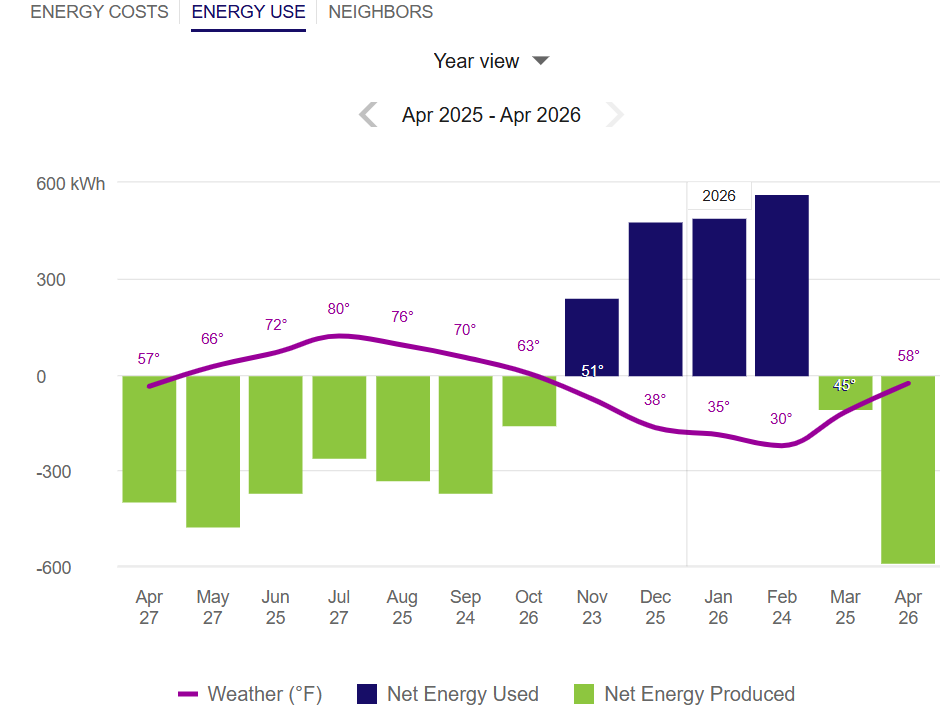
As you can see, for the most part of the year I generate way more electricity than I use, except for a few winter months when the sun isn’t out much. However, because of how much I generate, I build up credit with the electric company and I take from those credits to pay for the months with lower solar generation. With my electric company, when April hits I get a check from the electric company for anything that hasn’t been used. This year I got a check for $104.35 – and that was after deducting some of my earned credits (more on that below).
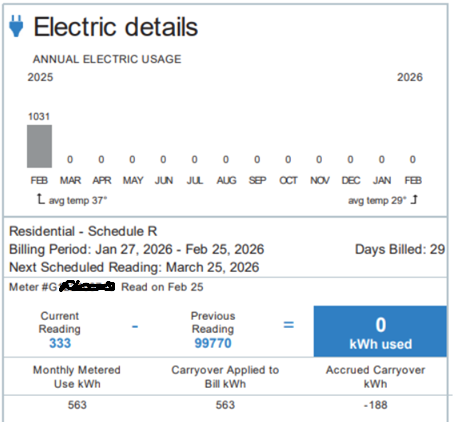
As you can see from the Feb 2026 bill above, my total usage was 0 kWh. In reality, in total for Feb 2026 I used 915 kWh. I generated 352 kWh from my solar system (that BGE can’t see and that I used) and I pulled 563 kWh from the grid (which they can see and try to bill me for). The neat thing is that because the system back feeds the grid all of the excess electric I generate, my electric company keeps track of that and I build up a bank of kWh I can use throughout the year when I don’t generate all of the electricity I need. As you can see, some of those credits (563 kWh worth) were applied to my Feb bill and my bill in reality was $0 – as you can see from the kWh used column highlighted in blue. So those 4 months above were totally covered by the excess electricity I sold to the electric company the other 9 months of the year. I have not had an electric bill since the system was installed and turned on (install date and activation date are different) as you can see above.
So all in all, if you factor in the SRECs and the loan, I’m paying $3,372/year for the loan and selling about 10 SRECs a year for an average of $45/SREC. If you break that down to a monthly cost, it’s on average $243.50/mo for electricity. For 2025, I generated a total of 10.5 MWh (10,500 kWh – which was super close to what Lumina Solar projected I would generate in the year). If I had to purchase all of my electricity from my electric company I would have paid $1,785 (or $148/mo) for the 10.5 MWh. Yes, I’m paying more than my electric usage since I have to pay for the system vs paying BGE for the electric – about $100 more a month. But we are still in the early stages of the system, and I have a complete whole-house backup system. Projections put the price in MD at $0.30/kWh if current trends keep up as early as 2030. Yes, I’ve erased my electric company bill – but I’ve traded it for a solar loan and a bet that prices will continue to rise. Once electricity reaches $0.27/kWh, I will be paying the same for my system as I would have for electricity if I bought it from the electric company. If it goes higher than $0.27/kWh (which we know it will at some point in the future), I end up coming out ahead, especially once I fully own the system vs. finance it.
Speaking of finance, let’s chat a little bit about my loan. Not taking SRECs into account, the loan is $281 a month. One thing I did to reduce the time to repayment was to set up bi-weekly payments. Essentially you do 26 1/2 payments (every time I get paid) instead of 12 monthly payments. This basically equates to one extra payment a year right to the principal. Doing this automatically reduces my loan repayment to 17.6 years instead of 20, and it didn’t cost me anything extra to do it. In fact, I will end up making money by saving interest payments to the tune of $5,899.01 over the life of the loan. So after 17.6 years, I own the system outright and no longer pay for electricity. And with the system I put in, I have REC Alpha panels, which boast a lifespan of 30-35 years plus (25 of those years under warranty).
The System
As mentioned above, I have a 24-panel solar system and a Tesla Powerwall 3 battery. The system size is 10.08 kW, which is a little on the smaller side, but my house isn’t that big so I would call that proportional to its size. To give a good idea of what the solar system looks like, I broke out my DJI Mavic Mini and flew around the house. Video below.
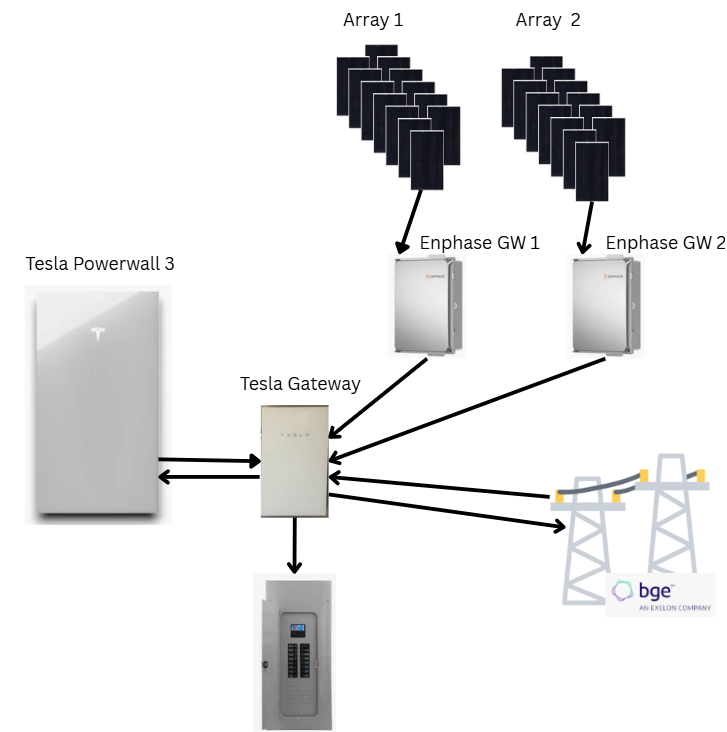
The panels are made by a company called REC Alpha. They are the Pure 2 REC420AA 420W Black on Black 132 Half-Cell Heterojunction Solar Panel (datasheet). Each panel is connected to an Enphase IQ8M Microinverter (datasheet). All microinverters are then homed back to one of 2 Enphase IQ Gateways. There is a Tesla Gateway that ties it all together and manages the flow of power between the panels, the house, the battery and the electrical grid. This is critical to support the Tesla Powerwall 3 (datasheet) as I am blending Enphase and Tesla ecosystems. I should probably note that if you plan to get a solar system and you want to blend technologies, this may break how you anticipate managing those technologies. Tesla and Enphase don’t play well together from an app or system dashboard perspective. You either have to be comfortable using multiple apps to get a holistic system view (especially when looking at exact usage metrics), or do what I did and tie it all together with Home Assistant. More on that in the monitoring section of this page.
For all you nerds out there like me, here is the schematic of my system (which was approved by my county for permitting).
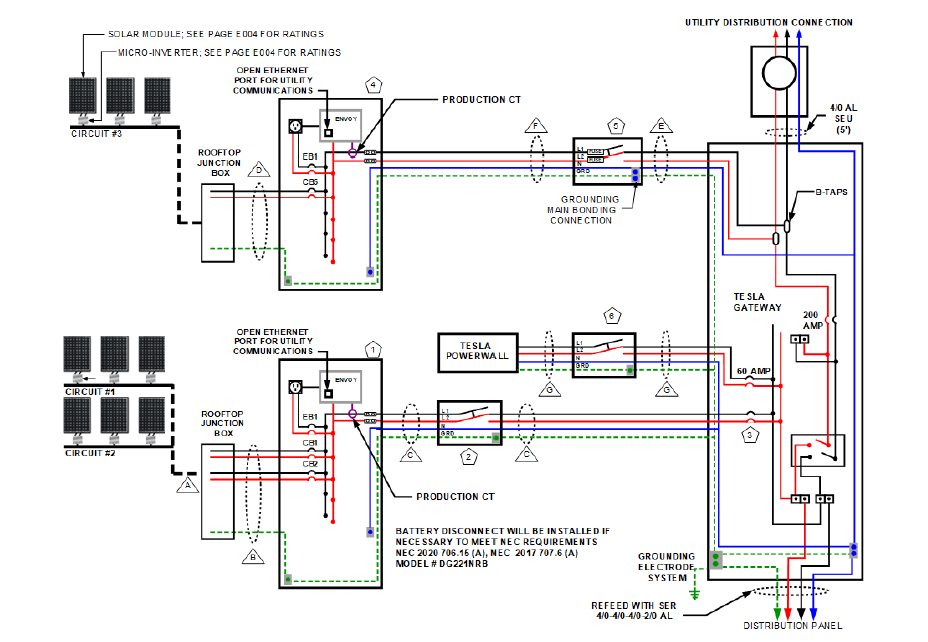
To simplify the above, here is a better view of the actual system. Everything in my setup centers around the Tesla Gateway. The Tesla Gateway is the connection to my home electrical panel. So everything funnels through that. Charging my battery from either solar or the grid – as well as sending excess electricity I make back to the grid. The nice thing about this setup is that my entire electrical panel is hooked up to the system. In traditional generator setups, you have to choose which circuits you want to back up – or get a separate sub panel that is backed up by the generator. In this setup, I can use any circuit I want and can avoid that scenario completely.
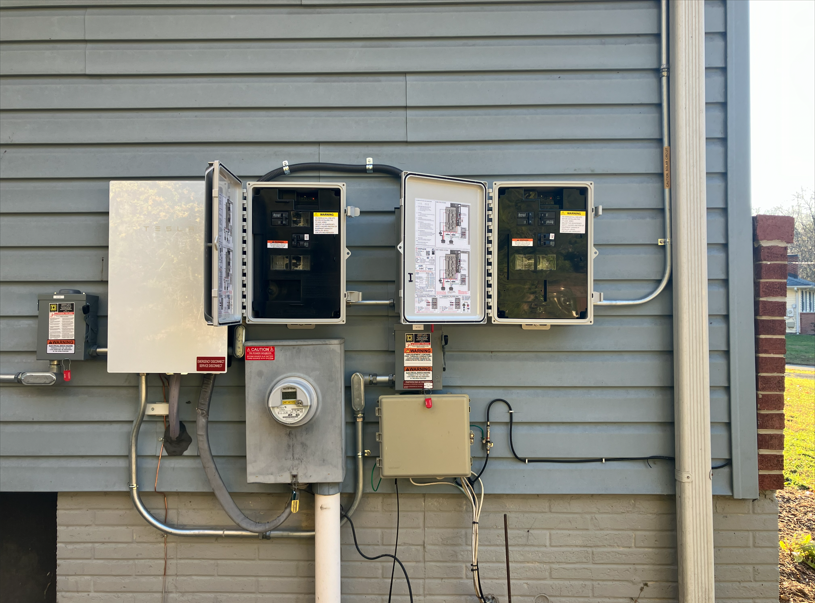
This is what all of this looks like on the side of my house. Normally the Enphase Gateways are closed and it’s more tidy, but this was the picture I had available while writing this. You can’t see the battery as it’s about 8 feet to the left of all the electrical connections. County permitting doesn’t want the battery under a window, so we had to push it down the side of the house some.
Monitoring
When it comes to monitoring your solar system, there are many options. Unfortunately for me, as I mentioned before – I blended technologies from different vendors. If you bought all the same gear from one company (like Enphase batteries and an Enphase Gateway), then monitoring would all be through one app or website. But that’s not where I am today. I blended Enphase and Tesla Gateways to achieve my goals, so for me it’s a little more complicated. But, being the engineer I am – let’s welcome the challenge.
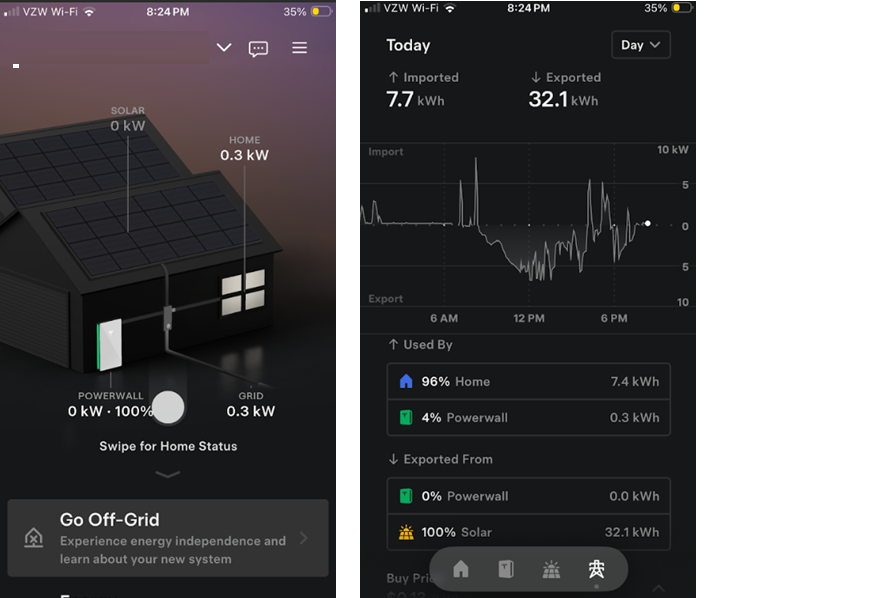
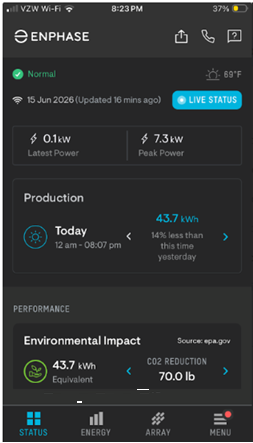
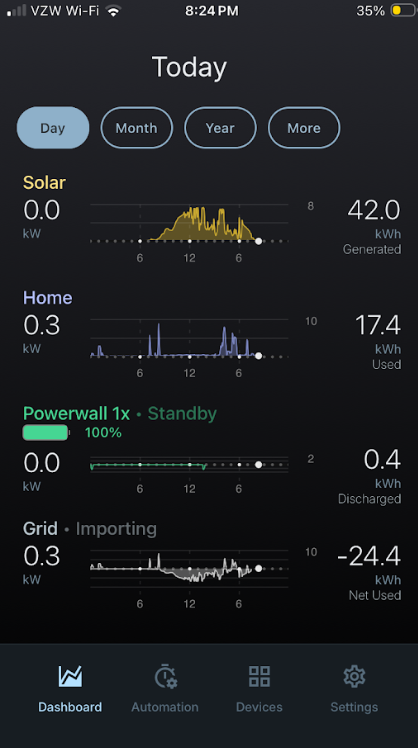
I can still access the Enphase Enlighten app/website – but it doesn’t account for my battery (either usage or charging) – so the numbers on how much my house consumes are slightly off. Using the Tesla app doesn’t answer the mail for me either since it can’t see the individual panels, but I do use it when the power goes out or if I want to manage the battery. Unless you set up Home Assistant, Teslemetry will be your best bet if you blend Tesla with Enphase as it gives you the most holistic overview. Here is a quick preview of the different apps.
Tesla:
Enphase:
Teslemetry: 3rd Party Tesla App (better overall view)
Monitoring with Home Assistant
The best way to describe how I monitor with Home Assistant is to see it in action. I made a quick video to show the web-based monitoring using Enlighten and Home Assistant and to show some key differences.
Final Thoughts
I have to say, based on the fact that I haven’t had an electric bill since we installed the solar panels, I would say this overall was a good investment for me. There are a few things I would change with my setup – but hindsight is 20-20. My main thing I would change would be to add 6 or so more panels on the back of the house since I don’t really start generating electricity until about 10am in the winter and that’s when we generate the least. Those extra 2-3 hours could offset some of my wintertime consumption – but this is just a minor complaint and when we did the solar I didn’t have the money. I will continue to update this page/blog as I learn new things about my system and if you want me to connect you with my Lumina rep (I do get a little kickback for doing so), feel free to contact me.